Water Droplets
A drum kit played by falling water.
2026 · installation · performance · one station built, four planned · visitor-playable
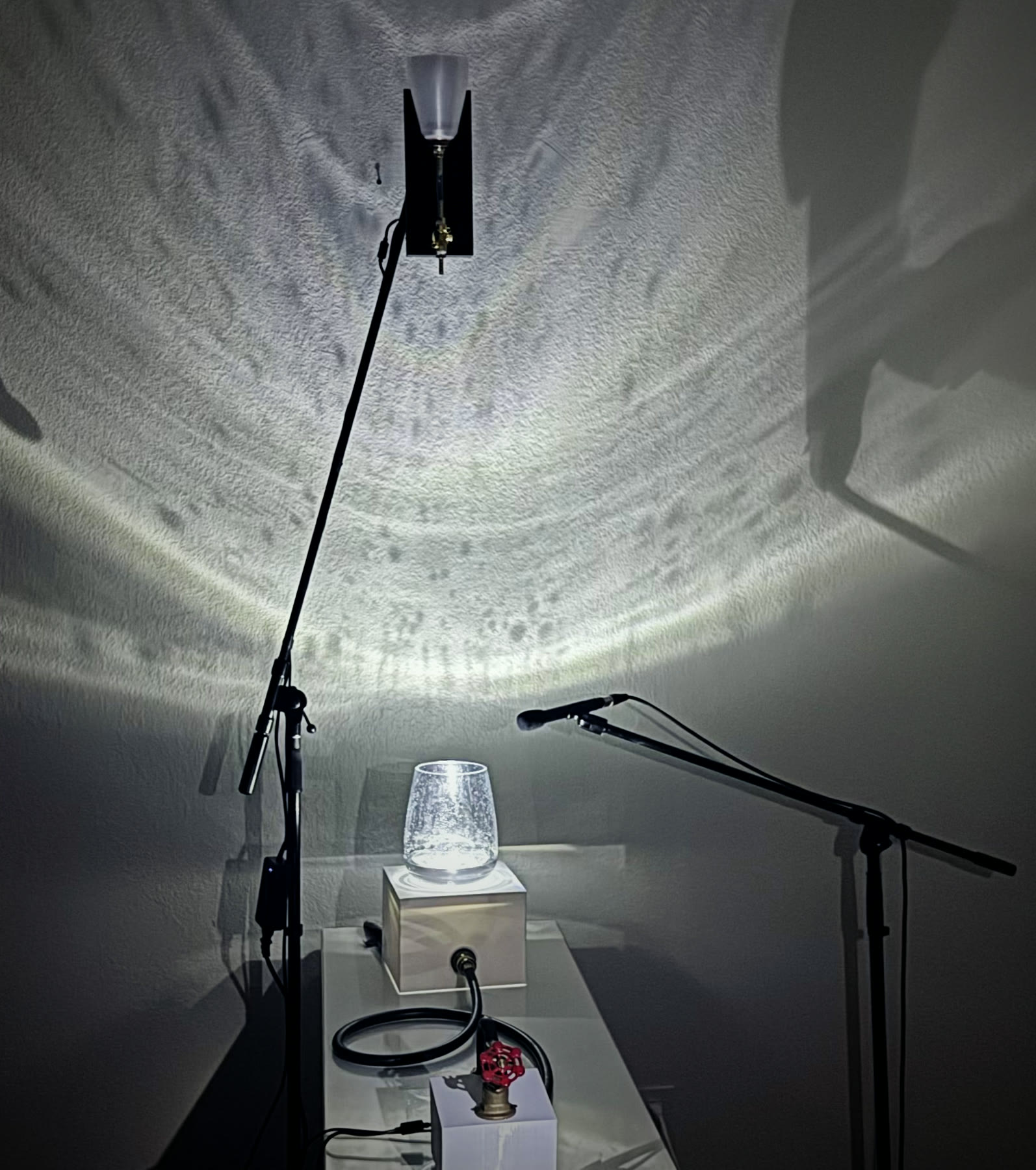
Turn the tap, and a brass valve clicks open above a glass vase. A drop falls, and under the surface a bubble rings: click, plonk. Keep turning and the drips gather into rhythm, water that was free and unpredictable, made to keep time.
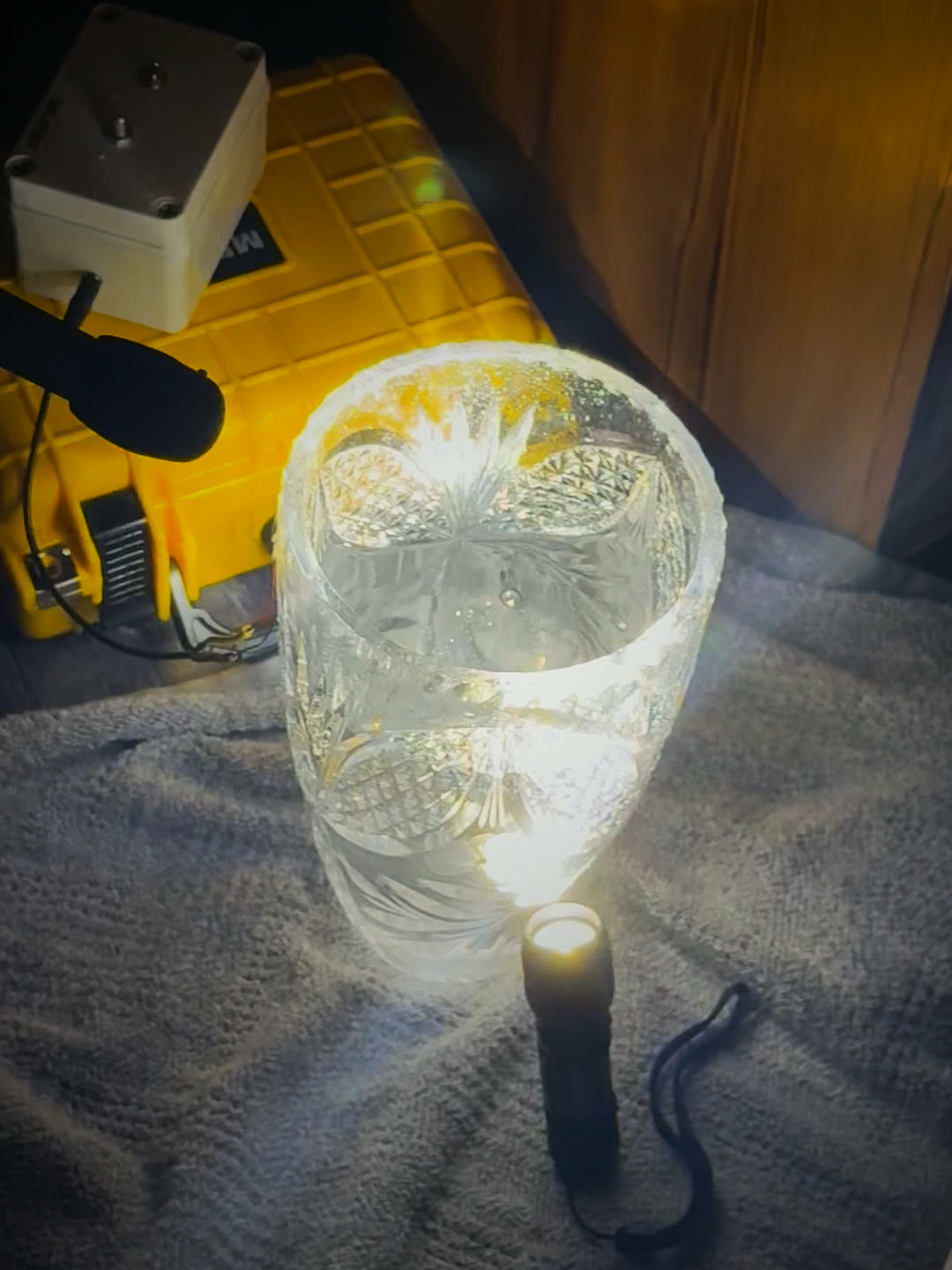
F 014 · bench-flashlight.jpg · 1080×1440
01 The bench
What does a drip need before it sounds like music?
I started with the idea of wanting to make rhythm with water droplets.
A lot of my work lives in the interplay between natural and digital. I like recreating natural things with algorithms, so they land in the part of the brain that trusts what it hears and also notices it's synthetic, held somewhere between real and fake. Water Droplets is that interplay, between mechanical and natural. I wanted to take something like water, which is free and unpredictable, and control it. Turn it into rhythm: something predictable, certain, and groovy.
At the time I was getting into Lachlan Turczan's work, and loved the water caustics piece he does with transducers in water. So I got a solenoid valve, a transducer and an IKEA metal mixing bowl, turned the lights out, and shined a flashlight into the metal. A few problems arose. The solenoid made a clicking noise. The drops only made a good plonk if they were big enough, and only when there was enough water underneath and the surface was undisturbed. Too soon after another drop, or with ripples in the way, and the plonk just doesn't happen. Which is why I killed the transducer: it disturbed the water. And the light in reflection dispersed too much to throw any real caustics.
Then I tried a bunch of different vessels: flat ones, big steel pots, a few glass vases. The glass vases colored the sound, like a reverb almost, and the big steel pot rang in sympathy. That was the thread I followed.
Further in
The first valve rusted shut, so now only distilled water goes through the brass. It was replaced with an ASCO Red Hat, a valve built for long duty cycles.
The first bench, September 2025: the IKEA bowl, the valve in its box, and a cat. The yellow case is the contact mic I tried first; the condenser on the stand turned out to be best.
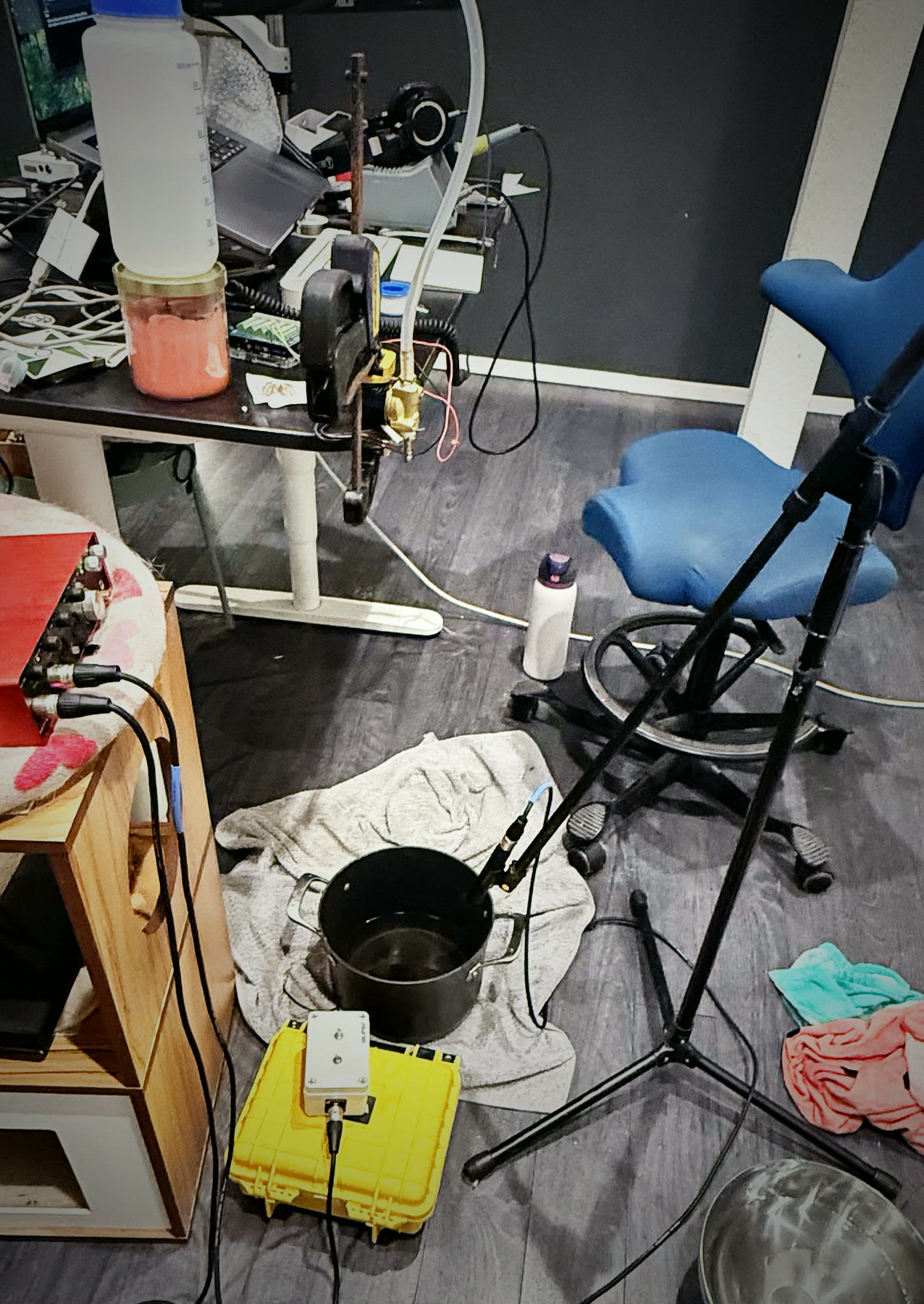
The bench in the room: the feed bottle and valve on the desk, the pot and the bowl on the floor.
F 006 · loop-glass.jpg · 1280×720
02 The physics
Why does a drip go plonk?
The plonk isn't the sound of a drop hitting water. As the drop goes in it traps a tiny pocket of air, and that bubble rings as it closes, like a struck bell: the smaller the bubble, the higher the note (Phillips, Agarwal & Jordan, Scientific Reports, 2018). That's every bench lesson in one sentence. A small drop doesn't trap a bubble. Shallow water doesn't give it room to form. A rippled surface breaks it up before it can ring.
The vessel is the second instrument. The first time I tried a printed resonator with water it absolutely colored the sound, so I damped it with my hands, and it kept ringing. If the vase wasn't vibrating, how was it coloring anything? It's the air. A vase with a body and a neck is a Helmholtz resonator, the same thing that happens when you blow across a bottle: the air inside is the spring, the air in the neck is the weight, and together they sing one note. It's what the glass vases had been doing all along. Muffle the glass and the sound barely changes.
Source Phillips, S., Agarwal, A. & Jordan, P. “The sound produced by a dripping tap is driven by resonant oscillations of an entrapped air bubble.” Scientific Reports 8, 2018.
Further in
The bubble's ring is a Minnaert resonance. The tom isn't a Helmholtz resonator but a closed pipe, and its closed end is the water surface, so it gives odd harmonics only and its length is its one control. Purity against splat comes down to one dial, Q. The kick's neck flares a little at the mouth, which adds some overtones and looks better, and the snare keeps a straight throat. Water level is a free tuning knob.
The vase
Drag it any way to turn it, then shape the belly, the neck and the water. Press play and the note follows the shape.
207hz · G♯3 −2c
helmholtz · neck ø51 × 34 mm · 2.02 l of air · below the neck 213 hz
vase-gen · the voices at bench size · drag the vase any way to turn it
F 004 · loop-caustics.jpg · 1280×720
03 The voices
What if every vessel were a drum?
Once I knew the air was doing the coloring, I could design for it. I decided to make different vase designs for the tonal colorations I wanted, imitating a drum kit. The kick, a low note and a big resonator. The snare, like a smaller kick with a bit less color and more splat. The tom, a uniform resonator, so it's like a boomwhacker. And a wide open dish for the simple splat of a hi-hat. We built a parametric system to design them from, so the four felt continuous and each one unique, with the math tunable. Sixteen of those shapes got printed and recorded; they're all in the library below. Four made the kit: the ones that sounded most like a kick, a snare, a tom and a hi-hat, and least like each other.
Then came a lot of printing and recording. The gray prints were only ever for testing the sound: they held water for a few minutes, wept a little at the base, and that was enough. Originally I wanted to make the piece huge, but I decided to lower my vision, so the sizes I tested at became the real sizes. For this first station, on budget, I looked for a bought vessel closest to one I'd designed and ended up with a vase from IKEA that is very similar to the tom. In that one the sound is far more about the plonk than the coloration.
The finished vessels have to be clear, cast in resin or blown in glass, because of the light. An LED under each vase throws the moving water onto the walls and ceiling as caustics. They're my favorite part of the piece, and I don't want to lose them. They're like the perfect music visualizer.
Further in
Every vessel was recorded at the fill level I thought sounded best, with clean drops and "unsettled" ones taken too soon after the last, so the instrument sounds natural rather than sampled. Sometimes an extra drip weaseled its way in. That's in the library too.
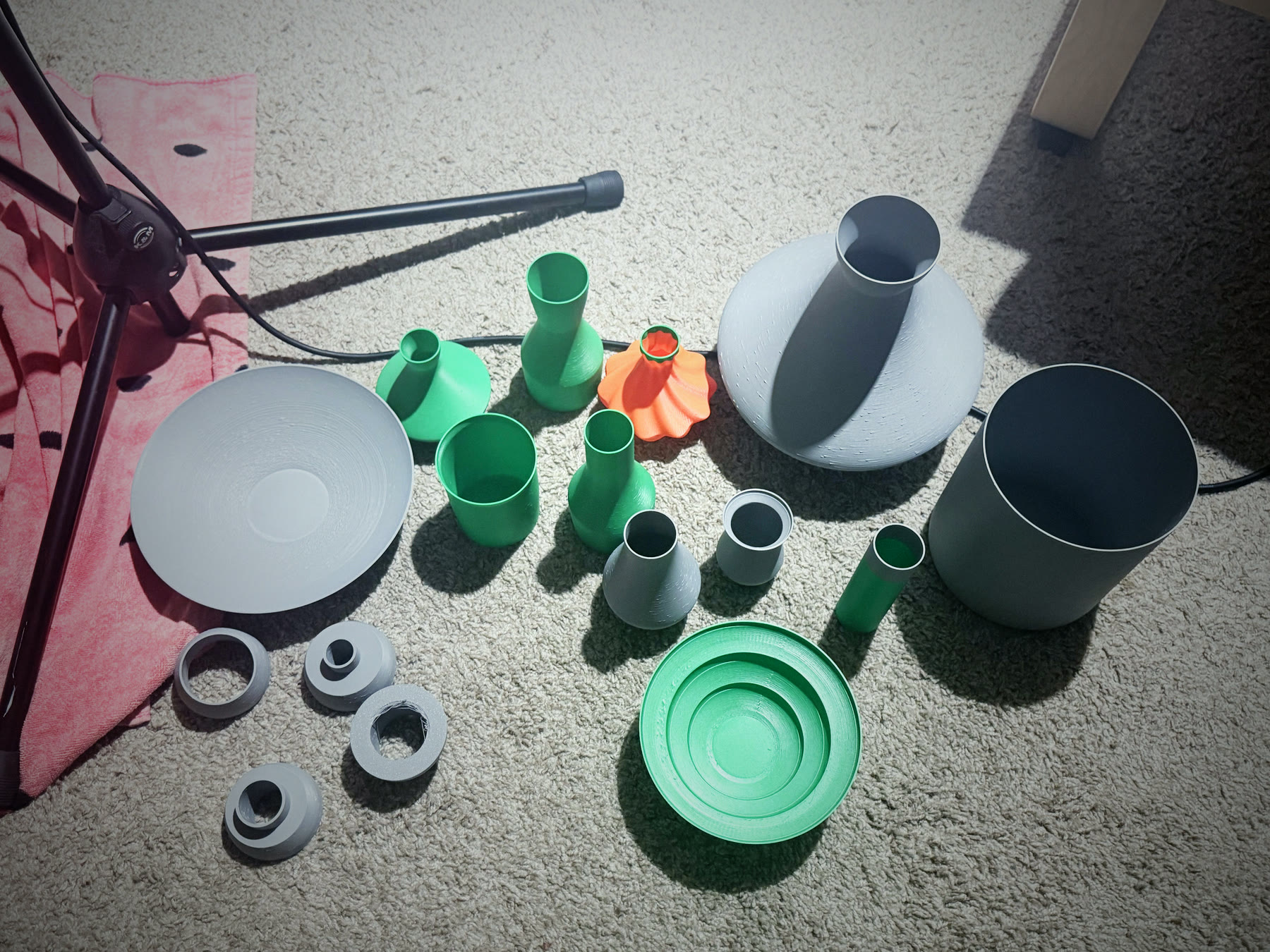
Every print recorded for the sample library. October 2026.
Recording the printed vessels, with supervision. October 2026.
Recording the printed vessels in the living room. Timelapse, 25 October 2026.
The glass vase on the station, lit from below.
tap a vessel to hear it
The vessel library
Sixteen vessels, 23 takes each. Tap one to hear its hero take; keep tapping for the rest.
16 vessels · 368 takes · 48 khz, cleaned, never normalised: the levels are as recorded
F 008 · loop-station.jpg · 1280×720
04 The click
What if the noise is the point?
The solenoid makes a loud, mechanical click. Originally the plan was to hide it. But the piece is about controlling nature, about a very specific mechanical control over a wild source, and the click is that control made audible. So instead of muffling it, I leaned on my musical instincts and made delay a core property. The click happens. The drop falls. The height between the valve and the vase becomes the length of the delay, and that repeat becomes the character of the piece. Click, plonk. Mechanical, then natural.
It gets more interesting when the notes get longer. A quick on and off sounds like onoff... plonk. A held note is on... long drip... off... the drip carrying on. Sometimes the valve closing lands on a plonk, or opening lands as one ends, and the layers start talking to each other.
On this station the valve sits 34 in above the water, which is about a 440 ms fall. The height sets the tempo. The light follows the click as well: the LED under the vase swells when the math says the drop lands, the way it would if a mic on the vase were driving it, only there isn't one.
Further in
Naive free fall gets it slightly short, so falls are solved with air drag and the valve's lag before the drop lets go. To compose for it I built a digital twin of the valve in Max for Live: note on is the open click, the fall is the delay, the note's length picks drop or pour, note off is the close click. As if I had the solenoid at a distance above the vases and was pressing a button to open and close it. It's not a complex concept; the programming is what's difficult.
A drop falling from the valve into the glass.
A held note: a stream falling into the glass.
Drop one
Press a vase: the click, the fall, the plonk. Hold it for a longer note, from a drop to a pour. Raise the valves and the plonk comes later.
hold a vase: up to 110 ms open is a drop, 165 half and half, 250 a pour
34 in above the water · fall 439 ms · close click 42 ms after you let go
F 002 · loop-greenmat.jpg · 1280×720
05 The tap
How should you play water?
I knew I wanted it to be interactive from the start, and pretty immediately the idea was a spigot. My first plan was a potentiometer with a handwheel on it, and it felt wrong straight away: it lost the tactility we all know, killing the effect at the beginning. A potentiometer is also something the public breaks in museums. You put angular force into it and it snaps off.
So I bought a real sillcock, the outdoor tap on the side of a house, built for years of being screwed and unscrewed. A magnet on the stem and a Hall effect sensor inside read how far it's turned. To fit the sensor I cast the inside of the tap in silicone, photoscanned the cast, and modeled a printed holder from it. Getting the magnet to stay on the stem took adapters, pockets, snap-on parts and a printed rod that broke off. All that, and I just glued it in place.
From off to fully open is about three and a quarter turns, and it starts dripping as soon as you turn it a little. To keep the metaphor alive, a hose runs from each tap to its station, carrying the signal on easily serviceable Cat 6. The wiring looks like plumbing.
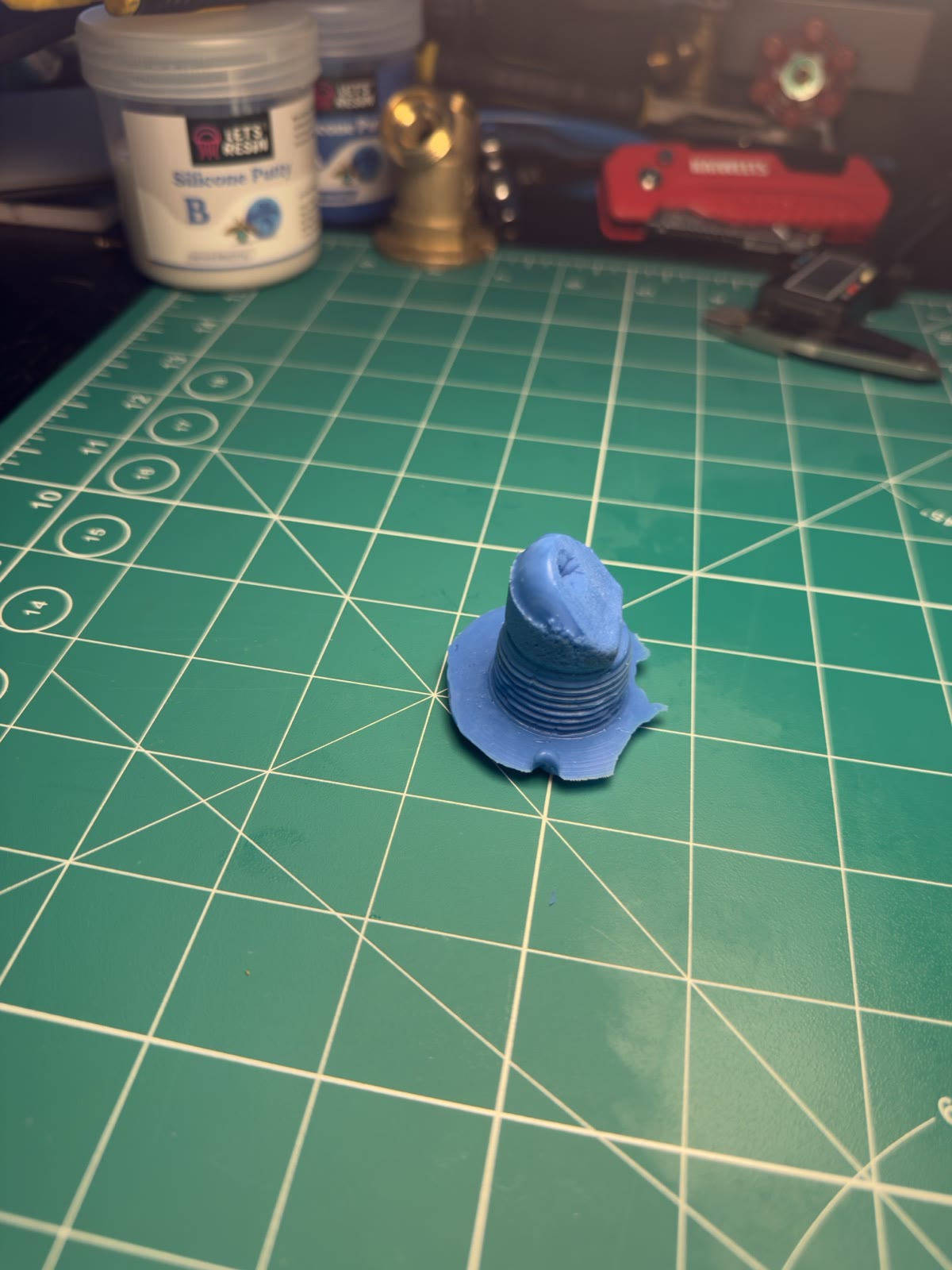
The bench, October 2026: a silicone cast of the silcock’s inlet port, taken so the Hall sensor’s printed mount could be modelled against the real brass. The silcock and its red handwheel stand behind it.
The tap on its plinth, its red handwheel, the hose running to the station.
F 012 · loop-knob-turn.jpg · 1280×720
06 Playing it
What happens when you turn it?
With the tap in the off position, it leaks a very slow set of rhythmic droplets. The more you turn it to the right, the more drops are added to the composition, fading between patterns drawn from drum traditions, until the most intense pattern lives all the way on the right. Lower down the notes are short and simple. Further up they get longer and looser, less quantized.
In the final four-station piece, four taps will make it a composition tool: more or less kick, more or less tom, a busy hi-hat over a plain kick, like some IDM. Every combination will be composed, never random. Every so often the light on the taps will fade out, so you know they're not active, and the piece will play a composition of its own.
Turn it
Drag the handwheel round. As the tap opens, the pattern fills and its notes get longer and looser.
closed: silence
bembe · 12/8 · two bars · quarter = the 439 ms fall · phrase 5.27 s · 91 bpm in dotted quarters · the tom
F 001 · loop-desk-solder.jpg · 1280×720
07 Built to be left alone
Can it run without me?
A piece people touch every day, with water on stage, has to be built for the technician who isn't me. Only low-voltage DC goes near the water, from a box on the stage floor. Each station has optocouplers to keep grounds apart, and the taps, the valves and lights, and any amplification run on separate circuits. The valve was chosen for high operating cycles and has repair kits. The taps come from a company that's been around a long time and will be for a long time to come. If a sensor dies, the whole unit swaps out.
To make it clear who gets to touch what, I named the sections like a theatre: FoH, stage and BoH. Front of house is what the audience gets to touch, the taps on their plinth. The stage is what the audience gets to see but not touch: the valves, the vases and the water, behind a stanchion, so nobody playing the piece is ever close enough to knock a vase over and any spill stays away from the public. Back of house is the stuff hidden inside the plinths, and only the techs get to touch it. The hoses run from front of house to the stage.
A priming and emptying system fills the station at the start of the day and drains it at the end. The vases lose about a millimetre a day to evaporation and get topped up with distilled water to a mark.
For this first station I used 3D printed boxes instead of full wooden plinths, for speed. Ideally there are two plinths, with the stanchion between them.
The station, 30 October 2026.
Closing
What’s left when you control water?
Water doesn't want to keep time. Every part of this piece asks it to anyway: a valve that clicks, a height that sets a delay, a vase shaped to hold one note, a tap you already know how to turn. What comes back is still water. The drops land a little differently every time, the light shakes across the ceiling, and the rhythm is never quite the one I wrote.
This is one station. The piece is four, and this page will grow with it.
The station, playing. 31 October 2026.
Singing with it
What happens when someone plays along?
Two days before the shoot, composing the sounds, I got a bit of a wave and started singing into my laptop mic. I built a three-voice loop and fell in love with it. It came up like a wellspring, which felt fitting for a piece made of water, and it seemed wrong to let it drain away. So I recorded it with the piece, and then sang along live.
It opens a future I'm excited about: the sculpture with company, improvised live looping sessions alongside it, with the artist present.
Singing with it. 31 October 2026.
Record
- work
- Water Droplets, 2026. Kinetic sound installation and performance: tuned glass vessels played by falling water, visitor-playable. One station built, four planned. Ongoing.
- artist
- Patrick Gates
- materials
- Brass solenoid valve, glass vase, LED, brass sillcock with Hall sensor, garden hose, Arduino, printed PETG.
- tools
- OpenSCAD, Blender, Ableton Live, Max for Live.
- AI disclosure
- The concept, composition, sound, vessel choices and every artistic decision are mine. I worked with AI agents as studio assistants: helping to program parametric CAD, firmware, Max for Live device, website, helped with research, and helped shape the text of this page from my own telling.
- source
- Phillips, S., Agarwal, A. & Jordan, P. “The sound produced by a dripping tap is driven by resonant oscillations of an entrapped air bubble.” Scientific Reports 8, 2018.
- about the artist
- Patrick Gates is an interactive multimedia artist exploring the failure points of algorithms as they relate to how people use technology, queer identity, and nature. They have been making digital art for over a decade and a half, working across sound, projection, machine learning and custom software, often building their own tools. In their work, the interface is part of the piece, not the frame around it. Patrick has a long history in theatre: they have acted professionally, including in West Coast premieres, won an acting award from The Old Globe, and been nominated for the Craig Noel Awards for projection design. For the past five years they have worked in museum design, where they are now Head of Creative Technology.